
A forklift advertised as capable of lifting two tonnes may appear suitable for a load weighing 1,800 kg. That assumption can be wrong. A truck’s stated capacity depends on conditions such as the load’s centre of gravity, the height at which it must be lifted and the attachments fitted to the machine.
When hiring a forklift, the right size is therefore not simply the largest tonnage you might need. It is a machine with a verified safe capacity for the actual loads and tasks involved. Understanding the capacity plate or load chart gives businesses a better basis for describing their requirements and discussing suitable equipment with a hire provider.
What Does a Forklift’s Rated Capacity Actually Mean?
A forklift’s rated or nominal capacity is a stated maximum load under specified conditions. Those conditions include a particular load centre and lifting height. It should not be read as permission to lift any object below the quoted weight, whatever its shape or position on the forks.
The Health and Safety Executive (HSE) calls the limit for a specific load centre and lift height the actual capacity, or safe working load. Its rider-operated lift-truck guidance, L117, says to use the capacity plate or chart on the truck and stay within the actual capacity for the lift.
A truck marketed as a two-tonne machine may have that rating at one defined load centre and lift height. A longer load, an attachment or a higher placement could reduce its permitted capacity. The difference between a nominal figure and the actual limit for a particular operation is central to safe selection.
Consider the load itself rather than using an average pallet weight. The heaviest item that needs moving, its dimensions, how its weight is distributed and the highest intended lifting position all matter. A supplier can then assess whether a proposed truck has adequate capacity for the full task.
How Do You Read a Forklift Capacity Plate or Load Chart?
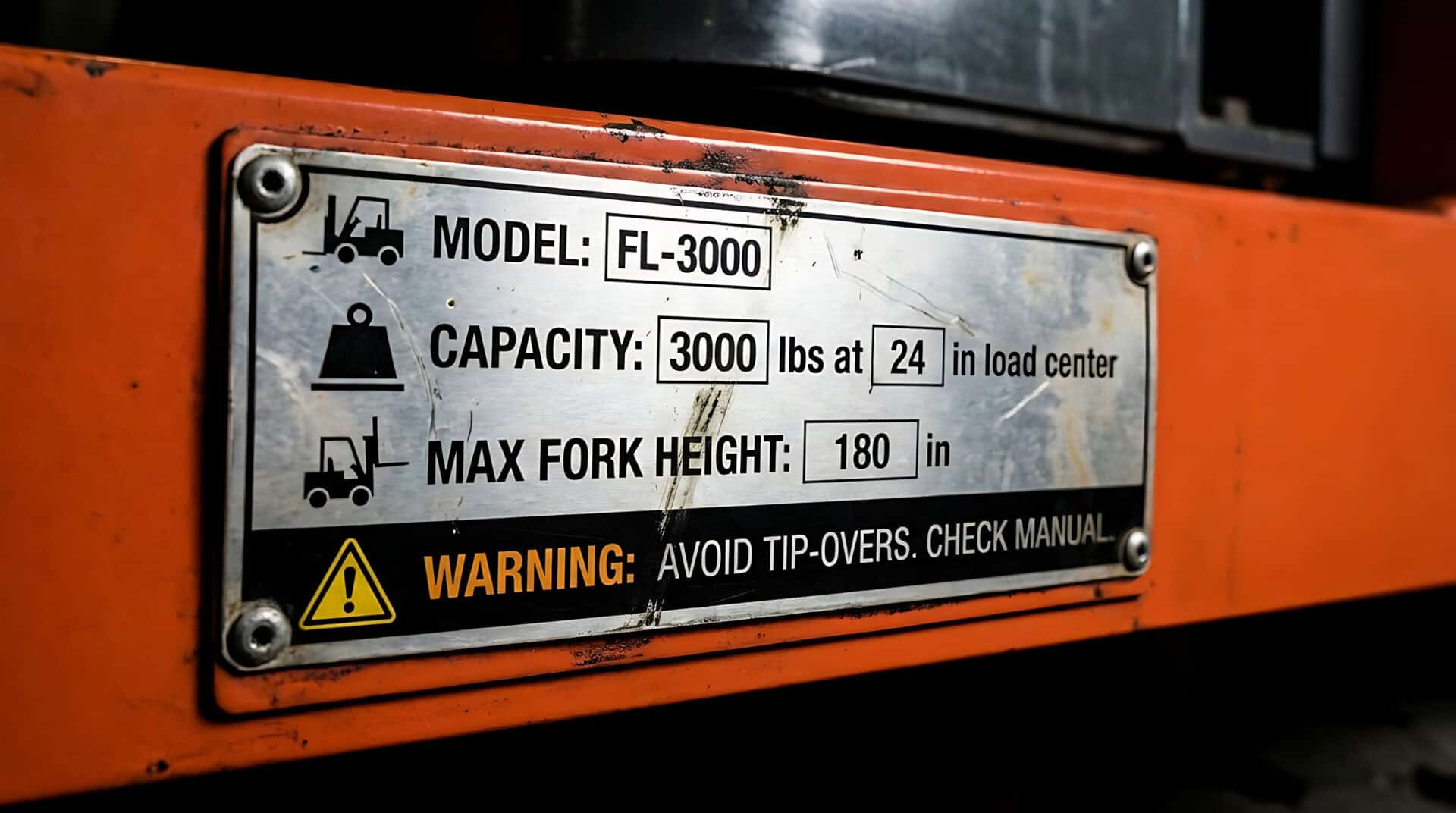
A capacity plate or chart identifies what the truck can carry under specified conditions. Depending on the machine, it may show one capacity figure or several values associated with different lifting heights and load centres. Always use the plate or chart fitted to the exact truck and its configuration.
Start by checking the identity of the machine and the units used. Capacity is commonly stated in kilograms, with distances and heights in millimetres. Find the relevant load centre and lift height, then read the permitted load for that combination. Do not select a figure from an unrelated row or assume that the highest number applies to every lift.
Check that the capacity information covers the attachment fitted to the truck. If the plate only shows capacity with standard forks, ask the manufacturer or authorised supplier for the rating for the fitted configuration before using the truck.
If the plate is missing, illegible or does not clearly relate to the installed configuration, the truck’s suitability should be resolved before it is used. A verbal estimate or a manufacturer’s brochure for another variant is not a substitute for the correct machine-specific information.
What Is Load Centre and Why Does It Matter?
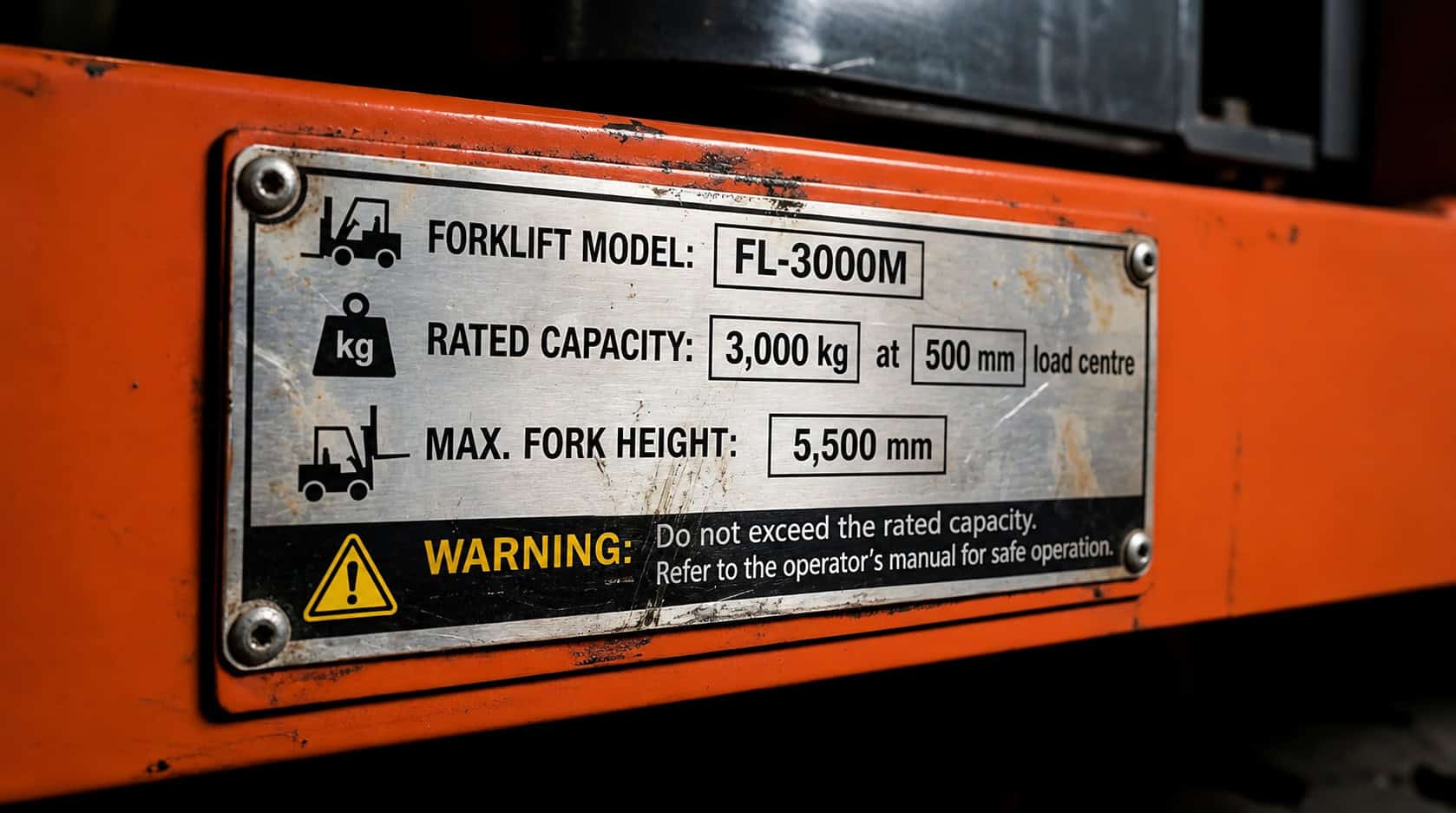
Load centre describes the horizontal distance from the vertical face of the forks to the load’s centre of gravity. It matters because the position of the load changes the forces acting on the forklift. A heavier load close to the fork heels is not equivalent to an equally heavy load whose centre of gravity lies much further forward.
For a uniformly distributed load, the centre may lie near its middle. A pallet that is unusually deep, a long bundle or an item with uneven weight distribution can put the centre of gravity further from the truck. The indicated nominal capacity may no longer apply at that greater distance.
There is no universal 500 mm load centre for every forklift. Toyota Material Handling UK gives examples involving 400 mm, 500 mm and 600 mm centres across different capacity ranges, while warning that individual truck data sheets can differ. These figures illustrate the principle; they do not establish a rating for a machine you are considering hiring.
Provide the supplier with the actual load length and width, information about how weight is distributed and any uncertainty about the centre of gravity. For unusual loads, obtain a proper assessment rather than calculating a safe figure from a simple rule of thumb.
How Do Lift Height and Mast Configuration Affect Capacity?
The lifting height needed for a job is part of the capacity assessment. A forklift may carry one weight at a lower working height but have a reduced permitted load at greater elevation. This is one reason the highest placement position should be included when requesting a machine.
The mast fitted to the truck affects the available lifting performance and may influence the capacity information. Different configurations of an otherwise similar model can have different residual capacities. The correct figure is the one specified for the actual truck and mast at the height required.
Residual capacity is the load the truck can lift at the required height and load centre in its fitted configuration. In Toyota’s published example, one 1,600 kg truck can lift 1,600 kg at 5,000 mm but only 1,510 kg at 6,000 mm, even with the load centre unchanged at 500 mm. Those figures apply to the configuration in the example. Use the plate or chart for the truck you will actually hire.
Tell the supplier the highest position at which the load must be placed, not simply the overall height of the storage area. Where relevant, identify the load dimensions and how it will be presented at that height. The supplier can then review the proposed truck’s capacity chart.
How Can Attachments Change a Forklift’s Rated Capacity?
Attachments may be needed to handle loads that ordinary forks cannot manage effectively. Examples include fork extensions, drum clamps, rotating equipment and other specialist handling devices. However, fitting an attachment can change the load position and the weight carried by the truck.
An attachment adds weight and can move the load further forward. Both effects matter when assessing the truck’s capacity with the attachment fitted. The reduction depends on the specific truck and attachment, so ask for the capacity for that combination.
HSE L117 says to seek advice from the manufacturer or supplier before using an attachment, including fork extensions. Consult the manufacturer or authorised supplier about compatibility and derating. Only someone with the appropriate knowledge and experience should determine the reduction. Fit a new capacity plate for the attachment before using the truck with it.
Describe the attachment and the load to your hire provider before confirming equipment. If you already own an attachment, do not assume it can be fitted safely to a hired truck. Compatibility, mounting arrangements, operating instructions and the resulting capacity need to be checked.
What Information Is Needed to Match Capacity to Your Load?
The most useful starting point is the heaviest load that must be lifted. Provide a confirmed weight where possible and explain whether that figure includes the pallet, packaging, container or other handling equipment. An incomplete load weight can undermine the whole capacity assessment.
Record the load’s dimensions and the way it is carried. Long, deep or irregular items may have a different load centre from ordinary palletised goods. Identify any known uneven weight distribution and tell the supplier if the centre of gravity cannot be established from the information available.
The maximum lift height is equally important. Explain the highest position at which the load must be handled, whether any relevant attachment is needed and whether the machine will perform the task repeatedly or occasionally. A single high lift of a heavy load can still determine the required specification.
The existing Forklifts4u guide about warehouse layouts covers aisle widths, access routes and physical space. Those are separate suitability questions that should be reviewed alongside, not confused with, the weight capacity assessment.
Confirming the Correct Forklift Capacity Before Hire
Before agreeing a hire, ask the provider to confirm that the proposed forklift is appropriate for the heaviest and most demanding lift, not just for typical movements. Check the rated and actual capacity at the relevant load centre, lift height and attachment configuration.
Ask for the correct capacity plate or chart and the applicable manufacturer information. If there is uncertainty about a long, unevenly balanced or unusually shaped load, have it assessed before selecting equipment. Do not rely on a calculation taken from a different forklift model.
The lifting operation must also be properly planned and carried out by appropriately trained people using suitable equipment. HSE L117 provides guidance on safe lift-truck use, while the machine’s own capacity information governs the permitted load for its configuration.
For businesses looking for forklift hire in Wolverhampton, Forklifts4u can discuss load weights, lifting requirements and suitable equipment options. To discuss a particular lift, email the team with the load weight, dimensions and required lift height.